

- Career Enquiries +91 8679-183-139 hr@efoxconsultancy.com
- Business Enquiries +91 6360-938-839 client@efoxconsultancy.com
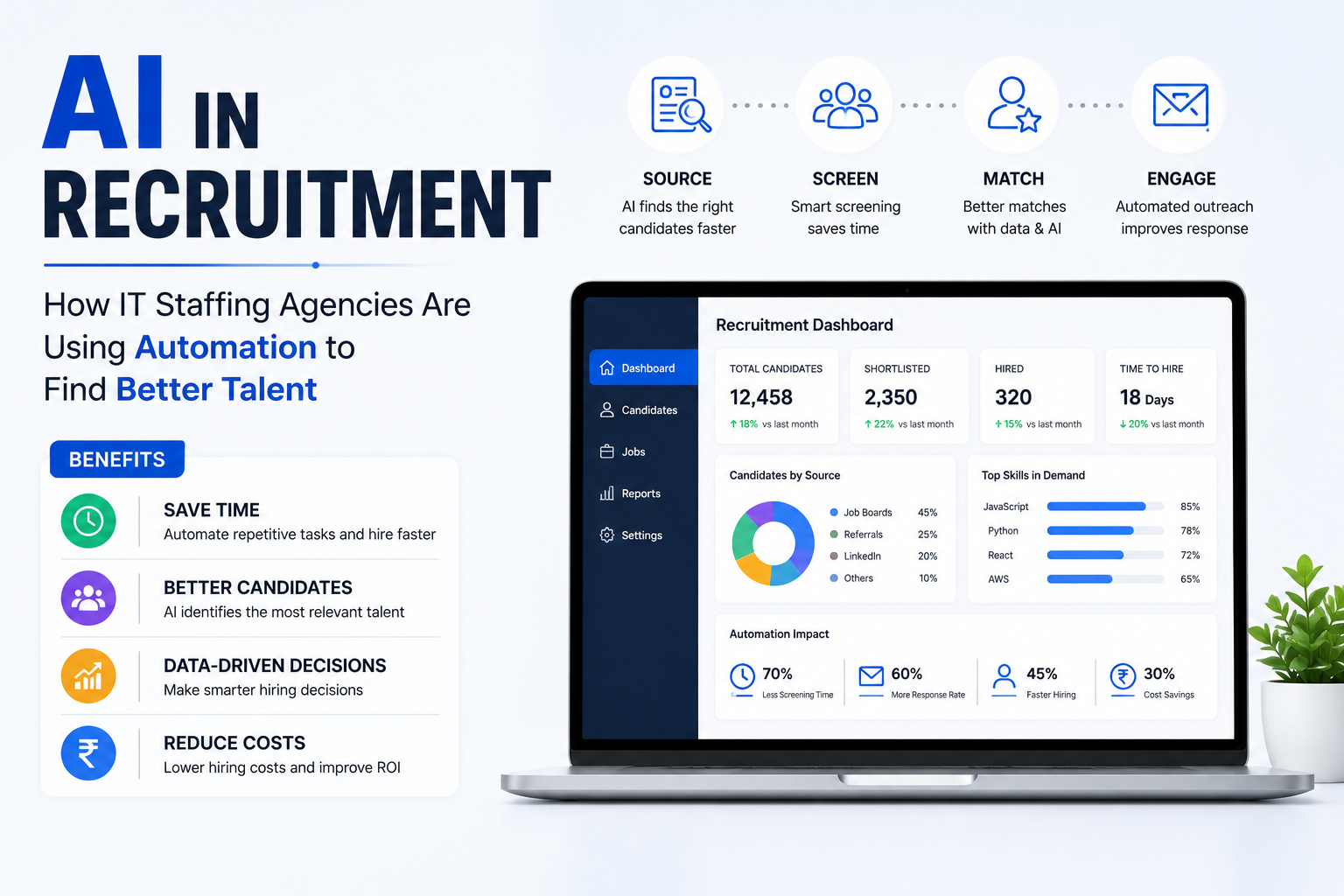
A recruiter at a Bengaluru IT staffing firm used to spend three days shortlisting 20 engineers from 400 applications. Now the same task takes four hours — and the shortlist is better. That’s not a hypothetical. That’s what AI in IT recruitment India looks like when it actually works, and in 2026, it’s working at scale.
The automated hiring process 2026 isn’t just about speed. It’s about reducing the noise that buries good candidates, eliminating the bias that sinks fair ones, and giving hiring teams time to do the thing machines still can’t — build real human connections with the people they’re about to hire.
India’s IT sector alone adds hundreds of thousands of jobs annually. The volume of applications is staggering. Without automation handling the first few layers of filtering, the whole process would collapse under its own weight.
This post breaks down how IT staffing agencies are actually using AI right now — not the hype version, the real one.
Three years ago, an IT staffing agency using AI recruitment tools India had a genuine competitive edge. Today, agencies that aren’t using them are struggling to compete. The shift happened faster than most industry watchers predicted.
India’s tech hiring market is uniquely demanding. The country produces over 1.5 million engineering graduates each year. Add career changers, upskilled professionals, and returning NRIs, and the talent pool is enormous — but so is the noise. Sorting through it manually isn’t just slow, it’s unreliable. Human screeners are inconsistent, influenced by irrelevant factors, and genuinely exhausted by volume. India’s leading IT companies recognized this early, and mid-size staffing agencies are now catching up fast.
Then there’s the candidate experience problem. When someone applies for a role and hears nothing for three weeks, they’ve already accepted another offer. The automated hiring process 2026 solves that too — faster acknowledgment, faster screening, faster decisions. Speed is now a retention tool, not just an operational metric.
People imagine fully automated hiring as a conveyor belt where resumes go in one end and offers come out the other. The reality is more layered, more human, and more interesting.
A typical automated hiring process 2026 at an Indian IT staffing agency runs roughly like this:
No well-run agency uses AI to make final hiring decisions. The best setups use it to protect human time — so when a recruiter does engage with a candidate, it’s meaningful.
AI recruitment tools India has grown into a full ecosystem. A few categories dominate what IT staffing agencies are deploying right now:
Resume Parsing & Matching
Resume parsing AI is the most widely adopted tool in the stack. Platforms like HireQuotient, Keka, and Darwinbox have built parsing engines tuned to Indian resumes — which differ structurally from Western formats. They handle vernacular formatting, abbreviated institute names, and inconsistent date notations better than generic global tools.
Predictive Hiring Analytics
Predictive hiring analytics goes a level deeper. Instead of just matching skills to requirements, it models which candidate profiles have historically performed well in similar roles — and uses that to score new applicants. When done with clean data, this dramatically improves first-year retention rates. The caveat: garbage data in, garbage predictions out.
Generative AI for Job Descriptions and Candidate Summaries
Generative AI staffing tools are changing how agencies create job descriptions and candidate briefing documents. Instead of copy-pasting from old JDs, recruiters now generate role-specific, keyword-optimized descriptions in minutes. Candidate summaries sent to clients are drafted by AI and reviewed by humans — cutting a 40-minute task down to 8.
Smart Candidate Screening Chatbots
Smart candidate screening via conversational AI has picked up significantly in 2025–26. Candidates interact with a chatbot that asks qualifying questions — availability, salary expectations, tech preferences, notice period — and only routes engaged, eligible candidates to human recruiters. Drop-off rates at this stage tell agencies a lot about how their JDs are resonating.
Tech hiring automation carries a risk that doesn’t get discussed enough in vendor brochures: it can systematize bias at scale. An algorithm trained on historical hiring data will replicate whatever patterns existed in that data — including the problematic ones.
India-specific risks are real. Models trained on hiring data from Tier 1 cities may systematically underrate candidates from Nashik, Coimbatore, or Bhubaneswar who attended less well-known colleges. Models that weight certain tech buzzwords may favour candidates who’ve learned to keyword-stuff their resumes over those with deeper but less flashily-named experience.
The answer isn’t to avoid AI in IT recruitment India — it’s to audit it regularly. Every three to six months, run a distribution analysis: who is your system surfacing, and who is it quietly burying? If your shortlists consistently over-represent candidates from a narrow set of colleges or cities, something in the model needs adjustment.
Agencies that get this right — that treat their AI tools as systems requiring ongoing oversight, not set-and-forget installations — will build fairer and frankly stronger talent pipelines. Much like how management software platforms need regular audits and updates to stay effective, recruitment AI is no different.
The most underused capability in the AI recruitment tools India market right now is predictive analytics. Most agencies have adopted parsing and matching. Far fewer have moved into genuine prediction — and the ones that have are seeing measurable results.
Predictive hiring analytics uses historical outcomes — who stayed, who performed well, who left in three months — to build models that score new candidates on those same dimensions. It shifts the question from “does this person have the right skills?” to “is this person likely to succeed and stay in this role?”
For IT staffing agencies in India, where client relationships depend on placement quality and retention rates, this distinction matters enormously. A candidate who looks great on paper and leaves in four months is a problem for everyone — the client, the candidate, and the agency. Predictive hiring analytics helps reduce that outcome when it’s used honestly and reviewed regularly.
The data requirements are real, though. Smaller agencies with less historical placement data will struggle to build reliable models from scratch. Partnerships with platform providers — or pooled anonymized data models — are emerging as solutions. Just as state-level digital adoption benchmarks, like those documented in India’s ERP adoption guides, help organizations understand where to focus, benchmarking hiring outcomes helps agencies calibrate their own models.
Generative AI staffing is the newest layer on top of established automation, and it’s changing day-to-day recruiter workflows faster than any previous tool.
In practice, it means: a recruiter describes a role in plain language, and the AI generates a complete, SEO-friendly job description in seconds. A candidate completes an initial screening, and the AI produces a structured briefing note for the client — highlighting strengths, flagging gaps, and summarizing the interview exchange. A hiring manager sends feedback, and the AI synthesizes it into actionable next steps for the recruiter. These used to be hour-long tasks. They’re now minutes. The cognitive load reduction is significant, and it compounds. Recruiters handling 30% more roles with the same attentiveness is not a small operational gain. Enterprise-grade platforms across industries have shown this same compounding effect when the right automation is applied to repetitive knowledge work.
The key constraint on generative AI staffing right now is hallucination. AI-drafted candidate summaries can confidently include skills the candidate didn’t actually claim, or misattribute experience. Human review before anything goes to a client is non-negotiable. The tool accelerates; the human verifies.
The automated hiring process 2026 comes with specific failure modes that agencies should understand before they go deep into AI adoption.
Over-automation kills candidate experience. If every touchpoint is a bot, candidates feel processed, not considered. The agencies winning on employer brand are the ones that use AI to make human interactions faster and better-prepared — not to replace them entirely.
Poor data hygiene breaks everything. Parsing AI is only as good as the data it’s fed. Old job descriptions, inconsistent role titles, and messy candidate databases produce garbage outputs that waste recruiter time and erode trust in the system.
Vendor lock-in is a real risk. Several AI recruitment platforms offer deep integrations that make switching expensive. Agencies should evaluate portability of their data and models before signing long-term contracts with any single provider.
Candidate privacy and consent are not optional. India’s Digital Personal Data Protection Act (DPDP Act) 2023 applies to recruitment data. Agencies running AI tools on candidate data need proper consent frameworks in place — not just a clause buried in an application form.
What is AI in IT recruitment India and how is it being used?
AI in IT recruitment India refers to using machine learning tools for resume parsing, candidate scoring, predictive analytics, and automated outreach. It’s being used by staffing agencies and in-house HR teams across Mumbai, Bengaluru, Hyderabad, and Pune to handle high-volume tech hiring more accurately.
How does an automated hiring process 2026 differ from traditional hiring?
Automated hiring process 2026 handles the first two to three filtering stages without human intervention — parsing, ranking, and initial outreach. Traditional hiring requires a recruiter to do all of that manually, which is slower and more prone to inconsistency. Humans still make final decisions in a well-designed system.
Which AI recruitment tools India-based agencies are using most?
AI recruitment tools India agencies commonly rely on include Keka, Darwinbox, HireQuotient, and integrations built on top of global platforms like Greenhouse or Lever. Resume parsing, chatbot screening, and predictive scoring are the three most adopted capabilities right now.
What is resume parsing AI and why does it matter?
Resume parsing AI converts unstructured resume data into clean, structured fields — skills, experience, education, certifications — that can be matched against job criteria at scale. It matters because manual data entry is the single biggest time drain in high-volume recruitment.
AI in IT recruitment India has moved from a differentiator to a baseline expectation. Staffing agencies that have built AI into their core workflows aren’t just faster — they’re more accurate, more consistent, and more attractive to clients who’ve seen the difference in placement quality.
None of this means the recruiter is becoming obsolete. The best outcomes consistently come from agencies where AI handles volume and humans handle judgment. Relationship-building, reading a room, knowing when a candidate is underselling themselves — these aren’t tasks that get automated in any near-term future. What gets automated is the grind that stops recruiters from getting to those moments in the first place.
For IT staffing agencies building out their automated hiring process 2026 stack, the right technology infrastructure matters from the ground up. Platforms that connect your ATS, your client management system, and your AI tools into a coherent workflow — rather than a pile of disconnected subscriptions — are what separate agencies that scale from agencies that just get busier. That’s where working with experienced technology partners like eFox Technologies makes a practical difference, not just a theoretical one.
The IT talent market isn’t slowing down. The volume isn’t shrinking. The agencies that will lead in 2026 and beyond are the ones building smarter systems now — and using those systems to make their people better, not redundant. Visit efoxtechnologies.com to see how the right digital infrastructure supports exactly that kind of growth.
|
AI in Recruitment: How IT Staffing Agencies Are Using Automation to Find Better Talent 21 May 2026, Efox Team |
|
Telehealth Is Creating New Jobs: What Healthcare Professionals Need to Know 19 May 2026, Efox Team |
|
Real Recruitment Success Stories from India: How Efox Consultancy Helped Hospitals & Businesses Hire Right 12 May 2026, Efox Team |
|
Best White Collar Consultancy Services in India | Efox 06 May 2026, Efox Team |
|
Bareilly Job Consultancy: Your Complete Career Guide 2026 15 Apr 2026, Efox Team |

No comments yet. Be the first to comment!