

- Career Enquiries +91 8679-183-139 hr@efoxconsultancy.com
- Business Enquiries +91 6360-938-839 client@efoxconsultancy.com
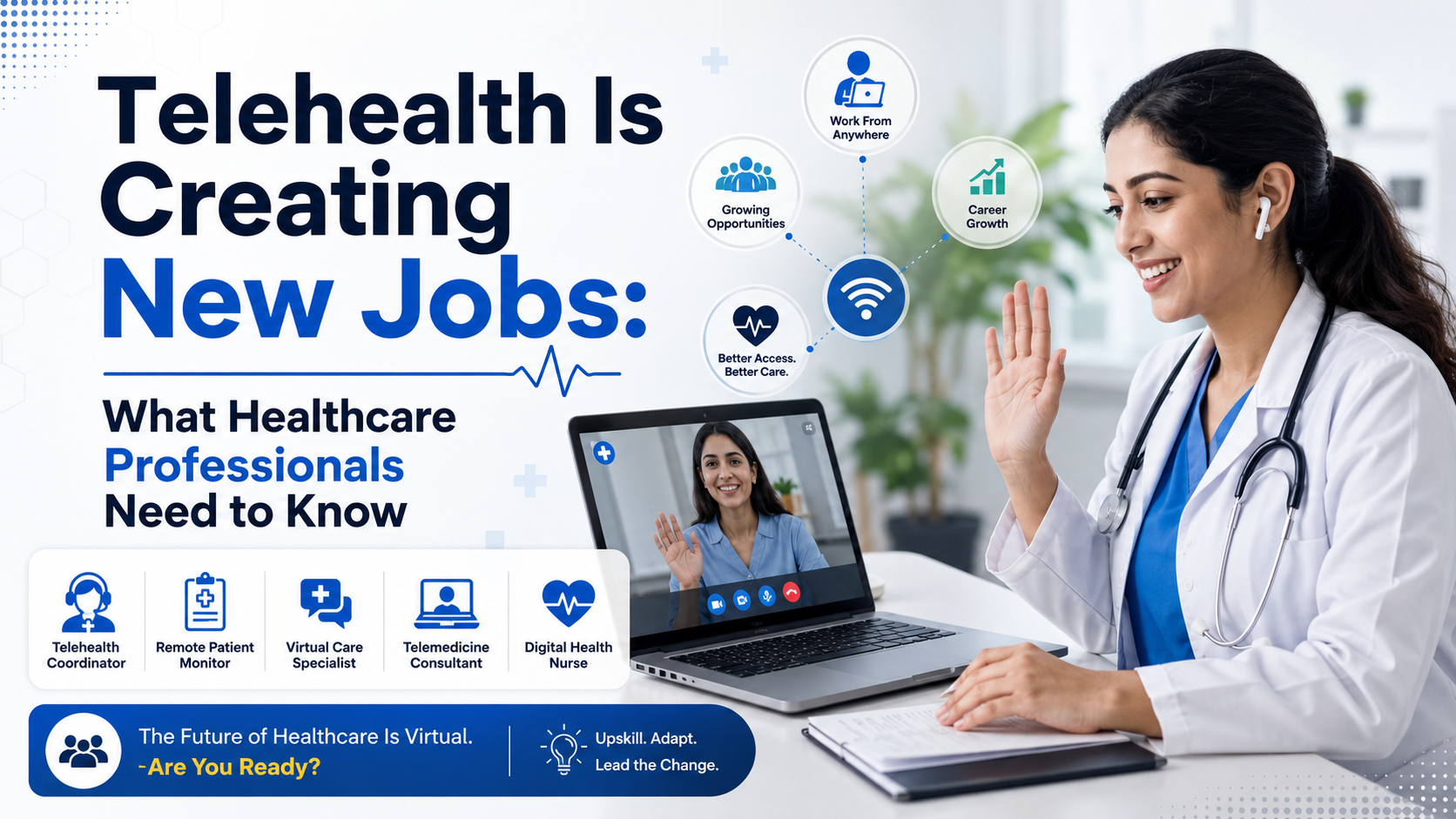
A radiologist in Jaipur reviews scans for a hospital in Kochi — without leaving his home. A nurse in Lucknow counsels patients in Bengaluru via video call, her shift ending before dinner. If you think these are outliers, think again. Telehealth jobs India 2026 is one of the fastest-growing segments in the entire employment market right now, and professionals who get in early are going to be very well-positioned.
Digital healthcare recruitment has shifted from a trickle to a flood. Hospitals, insurance companies, and health-tech startups are all hiring — and hiring fast. The roles aren’t just for doctors either. Coordinators, coders, pharmacists, mental health counselors, and even administrative staff are discovering that their expertise translates directly into this new format.
If you’re a healthcare professional wondering whether telehealth is for you, the honest answer is: probably yes. You just need to know where to look and what to expect.
That’s exactly what this post covers.
The pandemic pushed telemedicine into mainstream use almost overnight. But the hiring boom of 2026 isn’t really about the pandemic anymore — it’s about what came after it.
India’s National Digital Health Mission has been laying infrastructure across the country. States like Telangana, Maharashtra, and Tamil Nadu have expanded their digital health initiatives significantly. Private players have built platforms that need qualified staff to run them. Add the insurance sector’s pivot toward cashless and digital-first claims management, and you get an ecosystem hungry for talent. Companies building that digital backbone — much like how India’s leading IT companies have been driving enterprise software adoption — are reshaping how services are delivered.
Digital healthcare recruitment postings in India grew by over 60% between 2024 and 2025. The trend into 2026 shows no signs of reversing. If anything, demand is getting more specialized — which means salaries are moving upward too.
Telehealth jobs India 2026 is not a single job category — it’s an umbrella. Here’s what actually sits under it:
Clinical Roles
Non-Clinical Roles
Administrative and Strategic Roles
The non-clinical roles are often overlooked, but they make up a significant chunk of what companies are actively hiring for. A hospital platform without good support staff is just a broken app.
Cut through the vague job descriptions you’ll see online. When a company posts for digital healthcare recruitment in 2026, they’re typically looking for a specific combination of qualities.
Clinical competency is non-negotiable. You don’t get to skip that even if the role is remote. Employers want credentials, registration numbers (NMC, INC, or equivalent), and demonstrated experience. Remote doesn’t mean unregulated.
Comfort with technology. Not coding-level comfort — but you should navigate a video consultation platform, use electronic health records, and troubleshoot basic connectivity issues without falling apart. Doctors who freeze when a call drops don’t last long in this format.
Communication in text and voice. Telehealth often means written notes, follow-up messages, and concise explanations. Great in-person bedside manner doesn’t automatically translate to good written patient communication. That’s a skill worth building before you apply.
Adaptability. This one surprises some people. Telehealth setups change fast. Platforms get updated, workflows shift, and teams are often distributed across time zones. Employers want people who don’t file a complaint every time a process changes.
Just as enterprise platforms have helped sectors like education — think how school management software has reorganized institutional workflows — healthcare platforms are demanding the same mindset shift from their users: learn the system, trust the process, and adapt as things improve.
People sometimes romanticize remote healthcare jobs. Yes, you can work from home. Yes, you can structure your schedule more flexibly. But it isn’t a free pass to coast.
A typical teleconsultation shift involves back-to-back video calls — often 8 to 15 per session depending on the role and platform. Between calls, there’s documentation. After the shift, there may be follow-ups on prescriptions, lab results, or referrals. The pace is different from in-person, but it’s not slower.
The hybrid staffing model is becoming increasingly common. Some roles are fully remote, while others rotate between clinic and virtual. Companies in cities like Pune, Hyderabad, and Chennai are building arrangements where professionals split their week between on-site and remote work. This can be ideal if you want flexibility without losing the in-person clinical experience that keeps your skills sharp.
Digital transformation across sectors has proven that hybrid models work — from how top ERP platforms blend on-site and cloud-based access for institutions, to how health platforms now blend clinic and remote care. The principle is the same: meet people where they are.
Among all growth areas in the health tech jobs India market, virtual nurse hiring has been the most surprising. Nursing has traditionally been deeply hands-on. The idea that a nurse’s role could be effectively performed remotely sounded odd just five years ago.
But it works — and it works well for specific use cases.
Post-surgical follow-up, medication adherence support, prenatal care for rural women, chronic disease management for diabetics and hypertensives — these are areas where a virtual nurse adds real value. Virtual nurse hiring India isn’t replacing bedside nurses. It’s extending care into places and moments the traditional system simply couldn’t reach.
For Indian nursing professionals, this is a significant opportunity. Nurses with INC registration and some additional training in tele-nursing protocols — many now available through online certification programs — are finding roles that pay better than hospital positions and come with fewer night shifts. India’s push toward digital health access across states, similar to how state-specific digital tools have been benchmarked in fields like education software adoption , is creating the same kind of geographic reach opportunity in healthcare.
Nobody should walk into telemedicine staffing blind. There are real challenges, and acknowledging them is more useful than pretending otherwise.
Connectivity is still uneven. Rural patients often have poor internet or shared devices. This puts pressure on the professional to work around limitations, keep consultations functional at lower bandwidths, and manage patient expectations carefully.
Licensing and jurisdiction questions are still messy. A doctor registered in Maharashtra seeing a patient in Assam — what rules apply? The Telemedicine Practice Guidelines (2020) provide a framework, but gaps remain, especially for cross-border consultations involving NRI patients.
Patient trust is a genuine hurdle. A significant portion of India’s population, particularly in semi-urban and rural areas, is skeptical of video-based medicine. Building rapport on a small screen is a skill you actively have to develop — it doesn’t come automatically from clinical experience.
Burnout in telehealth is real. Screen fatigue, documentation load, and the loss of physical cues wear people down differently than in-person work. Building habits that protect your attention and energy from day one isn’t optional — it’s professional survival.
If you’ve decided you want in, here’s what actually moves the needle:
Update your resume for digital healthcare recruitment. Highlight any remote work experience, EHR tools you’ve used, or telehealth certifications you hold. If you have no telehealth experience yet, frame your adaptability and tech comfort strongly. Concrete examples beat vague claims every time.
Get certified if you haven’t already. Several platforms offer teleconsultation and tele-nursing certificates — short, practical, and recognized by employers. They signal you’ve made the effort, and that matters to hiring teams who receive hundreds of applications from clinicians with zero digital health background.
Apply directly to platforms. Practo, Tata 1mg, MediBuddy, and Apollo 24/7 all hire clinical staff through their own careers pages. Don’t rely exclusively on job boards — you’ll miss opportunities and face more competition.
Network with intention. LinkedIn is active with health-tech recruiters in India. Join groups specific to the digital health workforce. Comment intelligently on relevant posts. Recruiters do notice, and a warm connection beats a cold application almost every time.
Nail your video interview setup. This sounds obvious, but many candidates show up with poor video quality for a job that is entirely video-based. Good lighting, clean background, working audio. If you can’t get that right for an interview, employers will wonder how your patient consultations look.
What kinds of telehealth jobs India 2026 are available for doctors?
Telehealth jobs India 2026 for doctors includes teleconsultation, radiology, psychiatry, and dermatology roles on platforms like Apollo 24/7, Practo, and mfine — both salaried and per-consultation. Demand is highest for general physicians and mental health specialists.
How does digital healthcare recruitment in India typically work?
Digital healthcare recruitment is mostly online — apply via job portals or company careers pages, interview over video, and submit your NMC/INC registration proof. Timelines are faster than traditional hospital hiring, usually two to six weeks from application to offer.
Is virtual nurse hiring in India growing, and what qualifications are needed?
Yes—virtual nurse hiring in India is growing fast. INC registration is the baseline; experience in chronic disease management or maternal care and comfort with video tools gives you a strong edge.
What is a hybrid staffing model in healthcare, and how does it work?
A hybrid staffing model splits a professional’s week between on-site clinic shifts and remote virtual consultations. It’s increasingly popular in metros like Pune, Hyderabad, and Chennai for the flexibility it offers both employers and clinicians.
Telehealth in India isn’t a trend waiting to be confirmed. It’s a sector that’s already restructured how care is delivered, and it’s pulling healthcare professionals along with it—whether they planned for it or not. The professionals doing well with telehealth jobs India 2026 are the ones who stopped treating digital healthcare as a backup option and started treating it as a legitimate, long-term career track.
There’s a version of this future where healthcare professionals build strong, well-compensated careers without commuting two hours to a hospital and back. That version is available right now. The entry point is knowing what roles exist, what skills matter, and where to apply. You’ve now got that picture.
For healthcare organizations, health-tech startups, and recruitment teams building the digital health workforce of tomorrow, the technology backbone matters as much as the talent. Platforms that streamline management, onboarding, and distributed team operations are what make scalable telehealth delivery possible — the same way eFox Technologies has helped organizations across India build the operational infrastructure needed to grow and serve at scale.
If you’re ready to take the next step — whether you’re a healthcare professional looking for your first telehealth role or an organization trying to build out a telemedicine staffing function — explore what’s available at efoxtechnologies.com. The opportunity is real. The demand is there. The only remaining question is whether you’ll move on it before someone else does.
|
AI in Recruitment: How IT Staffing Agencies Are Using Automation to Find Better Talent 21 May 2026, Efox Team |
|
Telehealth Is Creating New Jobs: What Healthcare Professionals Need to Know 19 May 2026, Efox Team |
|
Real Recruitment Success Stories from India: How Efox Consultancy Helped Hospitals & Businesses Hire Right 12 May 2026, Efox Team |
|
Best White Collar Consultancy Services in India | Efox 06 May 2026, Efox Team |
|
Bareilly Job Consultancy: Your Complete Career Guide 2026 15 Apr 2026, Efox Team |

No comments yet. Be the first to comment!