

- Career Enquiries +91 8679-183-139 hr@efoxconsultancy.com
- Business Enquiries +91 6360-938-839 client@efoxconsultancy.com
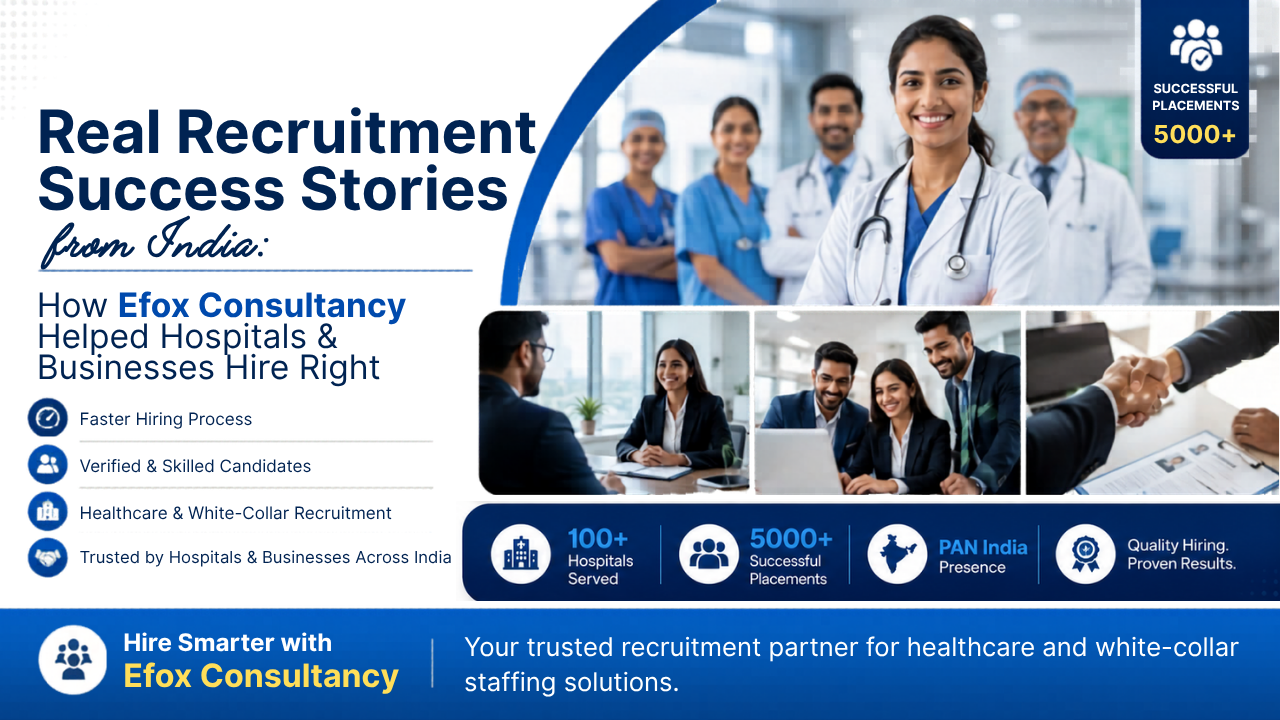
Picture this: a 120-bed hospital in Bareilly, operating at full OPD capacity, loses three nurses in the same week. No warnings, no handover. Just empty shifts, stretched staff, and patients waiting longer than they should. The administrator calls three agencies. One ghosts them. One sends CVs of people who don’t match the role at all. The third—Efox Consultancy—has two shortlisted candidates in front of them within 72 hours.
That’s not a highlight reel moment we invented for this article. That’s the kind of thing that happens regularly when recruitment success stories in India are actually built on process, not promises.
Hospitals, clinics, and businesses across Uttar Pradesh and beyond deal with hiring pressure that’s constant, unpredictable, and often urgent. The right hire keeps operations running; the wrong one — or worse, the unfilled seat — costs far more than money. What follows are anonymized case studies drawn from real engagements at Efox Consultancy. Names and identifying details have been changed, but the situations, challenges, and outcomes are real.
If you’re wondering whether a consultancy can actually deliver in your sector, these stories are your answer.
A 150-bed multi-speciality hospital in Western UP came to Efox with a recurring problem. They weren’t struggling to hire nurses — they’d hired plenty. The issue was retention. GNM-qualified staff would join, serve three to four months, and leave for better-paying positions in metro cities or private diagnostic chains.
The hospital’s HR head was frustrated. She wasn’t looking for a recruitment agency that could send 50 profiles. She needed someone who would understand why staff were leaving—and then source people who actually wanted to stay.
Instead of immediately pushing profiles, the consultancy team spent time understanding the hospital’s pay band, the working environment, the shift structure, and the geography of where the nursing staff was likely coming from. Candidates sourced from nearby districts—Shahjahanpur, Pilibhit, and Rampur—typically had lower migration risk than those from metros.
Within three weeks, six GNM nurses and two BSc nurses were placed. All eight had verifiable local roots, realistic salary expectations, and clear long-term intent. Fourteen months later, the hospital reports that seven of the eight are still in their roles. That’s a retention rate that their internal hiring had never achieved.
Their hospital staffing solutions approach is built around exactly this kind of contextual thinking—not just filling a vacancy, but filling it with someone who’ll actually stay.
A private clinic group with three centers in Bareilly had a medical officer resign with very little notice. For a facility running daily OPD, even a week without a duty doctor creates real problems: patient trust erodes, OPD revenue falls, and remaining staff get overburdened.
The clinic’s owner was skeptical about using a consultancy. His previous experience had involved being sent profiles of doctors who were either overqualified, unavailable, or had already accepted other offers. He reached out to Efox Consultancy half-expecting the same outcome.
The Efox team verified the role requirements carefully: MBBS, minimum two years post-internship experience, willingness to handle OPD and emergency cover, and availability within 10 days. They ran a focused sourcing process, leaning on their active candidate database and medical job platforms.
Three shortlisted profiles were sent within four days. All three were genuinely available; all three had verified credentials. The clinic conducted interviews on day five and six. An offer was extended on day seven. The doctor joined on day ten.
The clinic owner later mentioned that what impressed him wasn’t just the speed—it was that every candidate presented was actually real. No filler CVs, no time-wasters.
Efox’s doctor staffing solutions service operates with the same focused approach—credibility, availability alignment, and realistic timelines.
Not every story here is from the healthcare sector. A trading company in Moradabad needed a senior accounts executive who understood Tally, GST compliance, and could handle reconciliation independently—without needing six months of hand-holding. They’d tried Naukri.com, tried referrals, tried a local consultant. Nothing had stuck.
The problem? Everyone who applied either lacked the compliance experience or had inflated salary expectations the company couldn’t match.
Efox’s white collar team does something that job portals can’t: they screen for intent, not just skills. A candidate might have the perfect Tally experience but be actively looking to jump industries. That’s not a fit. Another might have slightly less experience but be stable, motivated, and willing to grow with the company.
Two weeks after the briefing, the company interviewed three candidates. One was selected. Three months in, they promoted him to handle their second branch’s accounts too. That’s a placement success story that no portal algorithm would have predicted.
Their white collar staffing services cover administration, finance, HR, and operations roles—with the same structured screening process applied to healthcare.
One of the more challenging recruitment success stories India has to offer involves a fast-expanding surgical hospital in Lucknow. They were adding a new modular OT and needed both OT technicians and a scrub nurse who could handle specialized instrument protocols. These aren’t easy profiles. Candidates with the right clinical background and OT experience are genuinely rare, and the few who have it are often already employed.
The hospital had been searching for three months before reaching Efox. Their HR team had approached seven candidates through various channels — two never responded to follow-ups, three wanted salaries significantly above the band, and two had experience that looked right on paper but turned out to be from low-volume facilities.
Efox’s healthcare team treated this differently from a standard nursing vacancy. They mapped the candidate profiles required by OT type, instrument familiarity, and patient volume capacity. They ran outreach specifically through clinical professional networks, not just job boards.
Within three weeks, they presented four candidates. Two were selected. Both had verifiable OT experience at facilities with comparable volume. Both joined within the month. The hospital’s new OT launched on schedule.
This particular engagement led to the hospital making Efox their primary staffing partner for all future clinical hires—which is perhaps the clearest signal of trust you can get.
You might be thinking, “Okay, these are good outcomes, but what’s the actual framework behind them?” That’s the right question.
A single good hire is luck. A pattern of good hires is a process. Here’s what consistently separates the placements that stick from the ones that don’t.
You can read more about their structured recruitment approach on the Efox Consultancy.
The feedback from clients after their first engagement with Efox consistently centers on a few themes. Not ‘wow, that was fast’ — though speed is often relevant. It’s more like, ‘That candidate actually understood the role,’ and ‘We didn’t waste time on irrelevant interviews.’
A hospital administrator from Muzaffarnagar put it plainly: her team used to dread recruitment drives because they’d spend entire afternoons interviewing people who shouldn’t have been shortlisted in the first place. After working with Efox, they interview two or three candidates and hire from that pool.
A business owner from Agra, who used Efox for front office hiring, noted that the candidate they placed stayed through a period of business uncertainty when most of his staff were making moves elsewhere. He credits the initial fit assessment for that.
These aren’t remarkable stories because the hires were perfect from day one. They’re remarkable because the right effort was put in at the front end, which is exactly where most hiring processes fall apart.
To see what Efox Consultancy has documented about their placement outcomes, visit their recruitment success stories.
Q1. What types of organizations can benefit from Efox Consultancy’s staffing services?
Efox primarily serves hospitals, clinics, diagnostic centers, and white-collar businesses across Uttar Pradesh and other Indian cities. Their core strength is healthcare staffing—nurses, paramedical staff, duty doctors, and OT specialists—but they also support office-based organizations needing accounts, administration, HR, and operations professionals. Both small multispecialty clinics and larger 150+ bed hospitals have worked with them successfully.
Q2. How long does it typically take to receive shortlisted candidates?
For most standard roles, Efox shares an initial shortlist within five to seven working days. For urgent requirements—particularly in healthcare, where patient care can be directly affected—they can often mobilize faster, sometimes within 48 to 72 hours. Timelines depend on role specificity, geographic location, and candidate availability, but the team is transparent about what’s realistic from day one.
Q3. Are the recruitment success stories India shared on this blog real placements?
Yes. All case studies on this blog are based on actual engagements handled by Efox Consultancy. Names, specific locations, and identifying details have been anonymized to protect client confidentiality and candidate privacy, but the problems, approaches, and outcomes described are accurate. This is not a marketing exercise — these are documented placement histories.
Q4. What sectors does Efox Consultancy focus on for hospital hiring success in India?
Healthcare is their primary sector, with deep experience in hospital staffing across clinical and non-clinical roles. On the clinical side, this includes GNM and BSc nurses, ICU and OT specialists, paramedical staff, and duty doctors. On the non-clinical side, they handle hospital administration, billing, front desk, and support roles. For non-healthcare businesses, they handle white-collar staffing across industries in Western UP and beyond.
Q5. How does Efox ensure candidates don’t leave shortly after joining?
Their approach specifically addresses retention risk at the sourcing stage — not after a candidate resigns. This involves geographic screening (sourcing from areas where candidates have local roots and fewer reasons to relocate), realistic expectation-setting on both sides, and post-placement follow-up to catch early friction before it becomes a departure. The retention outcomes seen in their hospital engagements are a direct result of this front-loaded effort.
Q6. Can Efox handle bulk or urgent hiring requirements?
Yes, they can support both urgent single-position requirements and bulk hiring drives, though they emphasize that speed should not come at the cost of fit. For urgent needs—a hospital needing a duty doctor in under two weeks, for instance—they have a well-maintained active candidate pipeline that allows for faster turnaround without compromising on credential verification and experience assessment.
Hiring is one of those things that looks simple until it isn’t. Any agency can send you CVs. Any platform can surface profiles. What’s actually hard — and genuinely rare — is a consultancy that understands why a hire needs to work, not just whether a candidate ticks boxes on a form.
The recruitment success stories India featured here share something important: in every case, the right outcome came from doing the unglamorous work up front. Understanding retention risk. Verifying credentials properly. Knowing when a candidate is available versus when they’re just testing the market. These aren’t flashy approaches. They’re disciplined ones.
Hospitals across UP—from Bareilly to Lucknow to Muzaffarnagar—have found that working with Efox Consultancy means fewer wasted interview rounds, better-fitting candidates, and meaningfully higher retention. Businesses in manufacturing, trading, and services have found the same. That pattern doesn’t emerge from luck. It emerges from a recruitment process that takes the requirement seriously from day one.
If your organization is dealing with a hiring challenge that feels harder than it should be—whether it’s an urgent clinical vacancy, a difficult-to-fill specialist role, or a white-collar position you’ve tried to fill twice already—Efox Consultancy is worth a conversation. Not a pitch. A conversation about whether they can genuinely help.
Start that conversation at efoxconsultancy.com, or reach out directly through their contact page. The right hire is worth getting right.
|
AI in Recruitment: How IT Staffing Agencies Are Using Automation to Find Better Talent 21 May 2026, Efox Team |
|
Telehealth Is Creating New Jobs: What Healthcare Professionals Need to Know 19 May 2026, Efox Team |
|
Real Recruitment Success Stories from India: How Efox Consultancy Helped Hospitals & Businesses Hire Right 12 May 2026, Efox Team |
|
Best White Collar Consultancy Services in India | Efox 06 May 2026, Efox Team |
|
Bareilly Job Consultancy: Your Complete Career Guide 2026 15 Apr 2026, Efox Team |

No comments yet. Be the first to comment!